



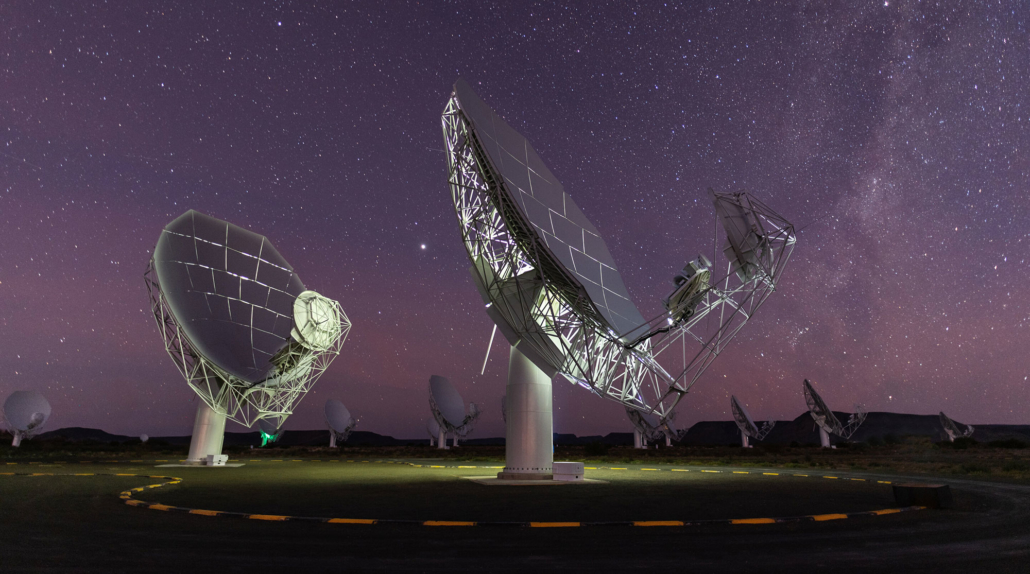
Illustrative Image: How Mega Satellite Constellations Threaten Astronomy in Africa: Starlink, SKA, and the Future of Dark Skies
Image Source & Credit: SARAO
Ownership and Usage Policy
Introduction: The Rise of the NewSpace Era
The last decade has witnessed a dramatic transformation in global space activity, often described as the “NewSpace” era. Unlike earlier periods dominated by government-led missions, the NewSpace age is characterised by the rapid entrance of private companies deploying vast networks of satellites in low- and medium-Earth orbits (LEO and MEO). Prominent players such as SpaceX’s Starlink, Amazon’s Project Kuiper, and OneWeb are spearheading this revolution, promising global internet access, real-time Earth monitoring, and new opportunities for economic and technological development.
While the benefits of such networks are undeniable—particularly in bridging the digital divide—astronomy has emerged as one of the sectors most threatened by this surge. Africa, uniquely positioned with its dark skies, minimal atmospheric pollution, and equatorial vantage point, has become a global hub for major observatories like the Southern African Large Telescope (SALT) and the Square Kilometre Array (SKA). These projects represent not only investments in scientific discovery but also tools of soft power, technology transfer, and education for the continent. Yet, the expansion of mega-constellations risks undermining these advantages through light pollution, radio interference, and orbital congestion.
The Scale of Satellite Expansion
As of April 2025, Earth hosts approximately 11,329 active satellites, an astonishing 320% increase from the roughly 2,700 recorded in 2022. SpaceX’s Starlink alone contributes over 7,000 satellites, nearly half of all operational spacecraft, and aims to scale this number to 42,000 in the coming decade. In comparison, OneWeb, Planet Labs, and Amazon Kuiper are each pushing hundreds to thousands of satellites into orbit.
This exponential increase marks an unprecedented shift in humanity’s use of near-Earth space. However, unlike terrestrial infrastructure—where expansion can be geographically zoned—space presents shared, global consequences that no single nation or institution can fully regulate.
How Satellites Disrupt Astronomy
1. Optical Interference
The most visible problem is satellite brightness. Metallic surfaces and solar panels reflect sunlight, producing bright streaks across telescope images. Wide-field surveys, which require long exposures to capture faint cosmic objects, are particularly vulnerable. A single streak can compromise an entire image, invalidating months of planning.
-
Brightness vs. Orbit: Satellites in lower orbits (300–550 km) appear brighter but move quickly across the sky, creating frequent but transient trails. Those at higher altitudes appear dimmer per pixel but linger longer, causing sharper and more disruptive interference.
-
Impact on African Observatories: Instruments across Egypt, Ethiopia, Morocco, and South Africa—from photometric cameras to spectrographs—are already reporting contamination. Studies suggest that with Starlink’s full expansion, 10–30% of images in leading observatories worldwide could be corrupted, with Africa facing comparable risks.
2. Radio Frequency Interference (RFI)
Unlike optical light pollution, RFI is invisible yet equally destructive. Radio telescopes, which detect faint cosmic signals in protected frequency bands, now find themselves competing with high-powered satellite transmissions.
-
MeerKAT and the SKA: South Africa’s MeerKAT array, the forerunner of the SKA, already detects Starlink and GPS signal leakage in its L-band (1–2 GHz). Although astronomers can “flag” contaminated data, excessive interference risks rendering entire datasets unusable.
-
Global Context: Even in Europe, arrays like LOFAR report rising interference, highlighting that Africa is not isolated from these global challenges.
3. Orbital Debris and Sky Brightening
Beyond active satellites, the accumulation of defunct satellites and fragments scatters sunlight and moonlight, subtly increasing night sky brightness. This phenomenon undermines Africa’s long-standing advantage of dark skies, particularly in rural observatory regions.
Why Africa is Particularly Vulnerable
Africa’s observatories are not just local assets—they are global scientific centres. SALT is the largest single optical telescope in the Southern Hemisphere, while the SKA, once completed, will be the world’s most sensitive radio telescope, capable of probing the origins of galaxies and cosmic structure.
Yet, the reliance of these projects on clear skies, low RFI, and stable conditions means that satellite constellations disproportionately threaten their operational integrity. Furthermore, African astronomy plays a critical role in:
-
Exoplanet discovery and monitoring
-
Transient phenomena detection (e.g., gamma-ray bursts, gravitational waves)
-
Near-Earth object tracking for planetary defence
Losing accuracy in these fields would not only slow African contributions but also impair global scientific progress.
Technical and Policy Responses
Technological Mitigation
-
AI-Driven Prediction Systems: Machine learning models can forecast satellite trajectories, allowing observatories to adjust schedules in real time.
-
Data Processing Tools: Automated flagging software now filters out strong RFI signals, preserving usable data from radio telescopes like MeerKAT.
-
Catalog Cross-Referencing: Tools like the Guide Star Catalog and Smithsonian Astrophysical Observatory catalogs help astronomers differentiate true celestial objects from artificial interference.
Policy and Regulation
-
South Africa’s UNOOSA Statement (2025): Highlighted the paradox of LEO satellites—individually less disruptive but collectively overwhelming due to sheer numbers.
-
International Coordination: The International Astronomical Union (IAU), through initiatives like SATCON and Dark & Quiet Skies, has pressed companies to reduce reflectivity. SpaceX has responded with dimmer second-generation Starlinks, though compliance remains voluntary.
-
United Nations Action: At the 61st COPUOS session in Vienna (2025), satellite constellations were added as a standing agenda item for five years—an important step toward structured global governance.
The Future: Balancing Connectivity and Discovery
The dilemma posed by satellite constellations reflects a broader global tension: how to balance technological advancement with the preservation of scientific frontiers.
-
For Africa: Continued investment in infrastructure like SKA, SALT, Entoto, and Kottamia must be paired with active participation in global space governance.
-
For Industry: Operators must innovate designs that minimise brightness, adhere to radio frequency protections, and responsibly deorbit satellites.
-
For Policy Makers: National governments across Africa must not only defend their skies in global forums but also establish regional frameworks to regulate satellite activity over the continent.
Conclusion
Africa stands at a crossroads. On one hand, mega-constellations offer transformative opportunities to expand internet access, stimulate economies, and close digital divides. On the other, they pose a serious risk to Africa’s astronomical heritage and scientific leadership.
The challenge, therefore, is not to halt satellite expansion but to integrate astronomy into the conversation of sustainable space use. By combining technological innovation, regulatory foresight, and international cooperation, Africa can help shape a future where global connectivity and cosmic discovery coexist rather than collide.











 The African Research (AR) Index is a comprehensive scholarly directory and database focused explicitly on journal publishers that publish and disseminate African research.