


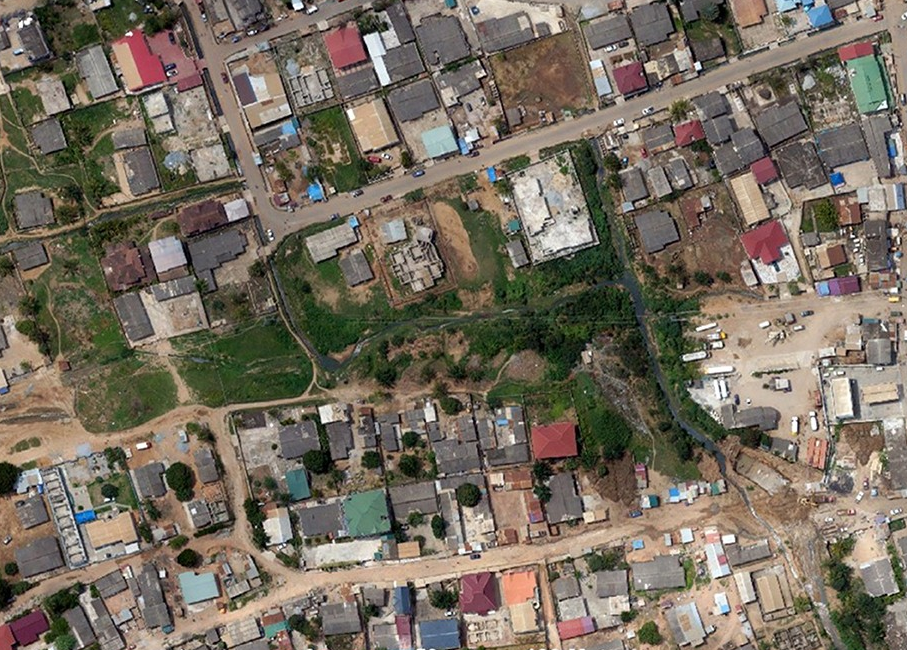
Illustrative Image: Urbanization and Wetland Loss in Sub-Saharan Africa: Causes, Impacts, and Sustainable Solutions
Image Source & Credit: Frontiers
Ownership and Usage Policy
A recent study by Mumuni et al. (2025) titled “A systematic review on the causes and effects of urbanization on wetlands in Sub-Saharan Africa” published in Urbanization, Sustainability and Society reveals that urbanization in SSA is rapidly degrading wetlands, reducing biodiversity, water quality, and livelihoods through multiple harmful urban growth patterns.
“
Urbanization in Sub-Saharan Africa is rapidly degrading wetlands, threatening biodiversity, water quality, and livelihoods through unsustainable growth patterns and poor planning.
– Mumuni et al. 2025
This systematic review examines the causes and impacts of urbanization on wetlands in Sub-Saharan Africa, offering a comprehensive perspective to guide sustainable urban planning and conservation efforts. Rapid urban growth—driven by population expansion, economic development, and policy decisions—is placing increasing pressure on natural ecosystems, particularly wetlands. These ecologically vital areas, which provide biodiversity habitats, water purification, and flood control, are being drained, filled, polluted, and fragmented as a result of construction, infrastructure development, and waste disposal. Such degradation not only threatens environmental health but also undermines the livelihoods of communities that depend on wetlands for resources and income. By synthesizing evidence on urbanization trends, environmental consequences, and socioeconomic impacts, the review underscores the urgent need for strategies that balance urban development with the protection and sustainable management of wetland ecosystems in the region.
How the Study was Conducted
The study employed a systematic literature review to rigorously examine existing research on urbanization and its impacts on wetlands in Sub-Saharan Africa. Guided by PRISMA protocols for transparency and comprehensiveness, the researchers conducted a targeted search in the Scopus database for English-language publications using keywords such as “Urbanization in SSA,” “Wetlands,” and “Population growth and wetland development.” Additional sources were identified through manual reference checks of selected articles.
From an initial pool of 968 publications, works published before 2010 were excluded, leaving 916. Titles and abstracts were then screened for relevance, resulting in 63 studies that met the inclusion criteria. Data from these articles were extracted and analyzed using abductive reasoning, with findings organized into three thematic categories: causes of urbanization, effects on wetlands, and urbanization patterns. Both deductive and inductive coding were applied to uncover recurring themes and trends, with the information systematically compiled in spreadsheets and reviewed iteratively for accuracy and depth.
To enhance analytical insights, the authors employed VOSviewer software to visualize co-authorship networks and keyword co-occurrence, highlighting research trends and hotspots. This structured methodology enabled the synthesis of fragmented studies into a coherent understanding of how urbanization is transforming wetland ecosystems across the region.
What the Authors Found
The study reveals a complex and regionally diverse picture of how urbanization is affecting wetlands across Sub-Saharan Africa (SSA). Urban growth in the region is primarily driven by rapid population increases, economic development, infrastructure expansion, and rural-to-urban migration. As urban populations swell, demand for housing, industry, and transport networks often encroaches on wetlands—landscapes that are frequently undervalued and repurposed for commercial or residential use. Informal settlements also proliferate in wetland zones due to shortages of affordable housing.
These pressures have resulted in significant ecological and socio-economic consequences. Wetlands—critical habitats for biodiversity and natural buffers against floods—are being destroyed, fragmented, or degraded. Their loss disrupts hydrological systems, increasing flood risks and diminishing water quality through pollution and reduced natural filtration. This in turn jeopardizes the livelihoods of communities that depend on wetlands for fishing, farming, and water access, deepening economic vulnerability and food insecurity.
The study identifies five distinct urbanization patterns shaping wetland outcomes in SSA: sprawling horizontal expansion into wetland areas; densification near wetlands that accelerates pollution and runoff; proliferation of informal settlements; fragmented urban growth that severs ecological connectivity; and even planned urban expansion, which can still harm wetlands when sustainability is overlooked.
Why is this important
Safeguarding Critical Ecosystems: Wetlands in Sub-Saharan Africa provide essential services—filtering water, buffering floods, supporting biodiversity, and sustaining livelihoods—yet they are increasingly undervalued and converted for urban use.
Informing Sustainable Urban Planning: The study offers evidence-based guidance for integrating wetland protection into city planning, promoting green infrastructure like artificial wetlands, and shaping policies that balance development with conservation.
Addressing Regional Urbanization Challenges: With some of the world’s fastest-growing cities, SSA faces unplanned expansion, informal settlements, and weak conservation frameworks, making wetlands highly vulnerable to degradation.
Highlighting Urgent Long-Term Risks: Failing to protect wetlands could exacerbate flooding, infrastructure damage, poverty, food insecurity, and climate vulnerability across the region.
What the Authors Recommended
The authors of the study offer a set of thoughtful and practical recommendations aimed at balancing urban growth with wetland conservation across Sub-Saharan Africa. Here’s what they propose:
- Recognize wetlands as critical infrastructure by embedding their protection into national and local development plans, supported by strong regulatory enforcement.
- Adopt nature-based solutions such as artificial wetlands and prioritize land-use practices that avoid wetland encroachment while preserving ecological integrity.
- Engage residents through education, participatory conservation initiatives, and livelihood support for those dependent on wetland resources.
- Promote cross-country collaboration within SSA and leverage international expertise, technology, and funding for wetland conservation.
- Conduct long-term studies on urbanization’s impacts, compare effects of different urban growth patterns, and develop context-specific conservation frameworks.
In conclusion, the study by Mumuni et al. (2025) makes it clear that the rapid pace of urbanization in Sub-Saharan Africa poses a serious and escalating threat to wetlands—ecosystems that are indispensable for biodiversity, water security, climate resilience, and community livelihoods. By synthesizing diverse research, the authors highlight not only the urgent environmental and socio-economic consequences of wetland loss but also provide actionable pathways for integrating conservation into urban development. Protecting these vital landscapes will require coordinated policy reforms, nature-based solutions, community engagement, and cross-border collaboration. Without decisive action, the region risks irreversible ecological damage and heightened vulnerability for millions of people who depend on wetlands for survival.








 The African Research (AR) Index is a comprehensive scholarly directory and database focused explicitly on journal publishers that publish and disseminate African research.