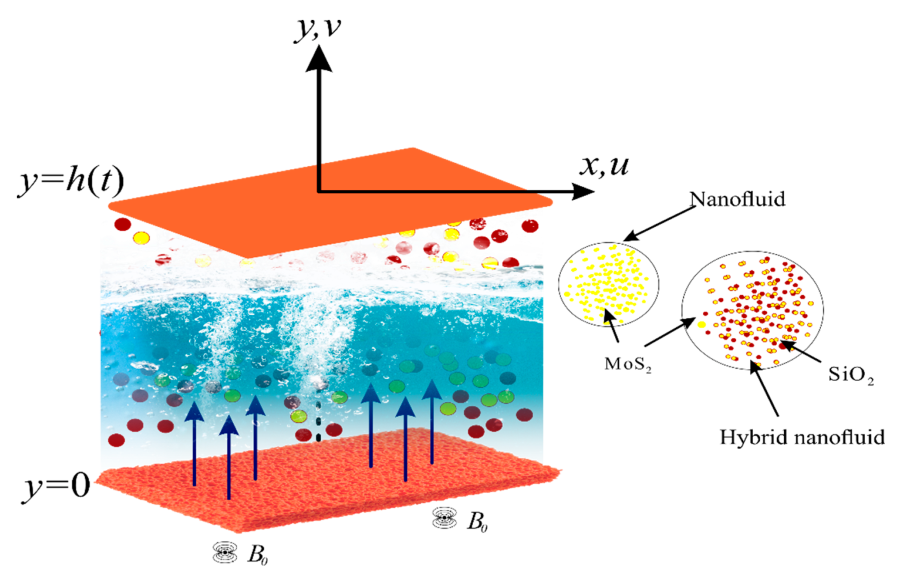
Illustrative Image: Numerical Analysis of Magnetohydrodynamic Silver Nanofluid Flow in Cylindrical Coordinates: Heat Transfer, Magnetic Field Effects, and Applications
Image Source & Credit: MDPI
Ownership and Usage Policy
A recent study by Ojo et al. (2025) titled “NUMERICAL ANALYSIS OF ENERGY TRANSFER ON MAGNETOHYDRODYNAMIC SILVER NANOFLUID FLOW IN CYLINDRICAL COORDINATE” published in Open Journal of Physical Science (ISSN: 2734-2123), reveals that applying a magnetic field alters silver nanofluid flow in cylinders, enhancing thermal conductivity yet reducing velocity and modifying boundary layer behavior.
“
Magnetic fields enhance silver nanofluid thermal conductivity but reduce velocity, significantly influencing heat transfer in cylindrical systems. – Ojo et al. 2025
The study explores the intricate relationship between fluid dynamics, magnetic fields, and heat transfer. Focusing on silver nanofluids—fluids infused with silver nanoparticles renowned for their superior thermal conductivity—the research investigates how these advanced materials respond to magnetic influences in cylindrical systems such as pipes, reactors, and biomedical devices. At its core, the study applies magnetohydrodynamics (MHD) to numerically simulate the transfer of energy within silver nanofluids under varying conditions. By analyzing parameters such as magnetic field strength, fluid velocity, and thermal conductivity, the research provides key insights into how magnetic forces shape fluid behavior and heat transport efficiency. The findings hold significant promise for real-world applications, ranging from industrial cooling systems and energy technologies requiring precise thermal regulation to biomedical innovations, including drug delivery mechanisms controlled by magnetic fields.
How the Study Was Conducted
The study employed a numerical simulation approach, where mathematical models were developed and solved computationally rather than through physical experiments. The governing equations were derived from the fundamental principles of fluid dynamics and heat transfer, including the continuity equation for mass conservation, momentum equations modified to account for magnetic effects, and the energy equation to describe heat transfer. Since the system under consideration resembled pipe-like structures, the equations were expressed in cylindrical coordinates. To capture the influence of magnetic fields, the Lorentz force was incorporated into the momentum equations. A uniform transverse magnetic field was assumed, which directly impacted both the motion of the silver nanofluid and its heat transfer behavior. Silver nanoparticles were chosen for the study because of their exceptionally high thermal conductivity. The fluid’s effective thermophysical properties were modeled by combining the characteristics of the base fluid with those of the nanoparticles. The system of equations was solved numerically using the finite difference method, a reliable technique for approximating differential equations. Appropriate boundary conditions were applied to simulate realistic flow scenarios within the cylindrical framework. The simulations generated graphical results that highlighted the variations in velocity, temperature distribution, and heat transfer rates under different operating conditions, particularly changes in magnetic field strength and nanoparticle concentration.
What the Authors Found
The authors found that applying a magnetic field significantly modifies the flow and heat transfer of silver nanofluids in cylindrical systems, with silver nanoparticles enhancing thermal conductivity but the magnetic field suppressing velocity and altering boundary layer behavior.
Why is this important
Engineering Efficiency – Silver nanofluids enhance cooling in electronics, reactors, and machinery, while magnetic fields enable fine-tuned thermal control.
Biomedical Applications – Insights help optimize nanoparticle behavior for targeted drug delivery and hyperthermia cancer treatments.
Environmental & Energy Impact – Improved heat transfer reduces energy use, supporting clean energy and sustainability.
Scientific Contribution – Advances magnetohydrodynamics by linking fluid mechanics, electromagnetism, and thermodynamics for innovative technologies.
What the Authors Recommended
- While silver nanoparticles showed promising thermal performance, the authors suggested investigating other nanoparticle materials to compare efficiency and cost-effectiveness.
- They recommended conducting physical experiments to validate the numerical results and strengthen the reliability of the simulation models.
- Future work should focus on optimizing parameters such as magnetic field strength, nanoparticle concentration, and flow geometry to maximize heat transfer.
- The authors encouraged tailoring the model to real-world systems like biomedical devices, heat exchangers, and microfluidic channels for more targeted insights.
- In addition, they proposed incorporating factors like radiation, chemical reactions, or variable viscosity to make the model more comprehensive and realistic.
In conclusion, this study demonstrates how silver nanofluids under magnetic influence can revolutionize heat transfer technologies, offering transformative benefits across engineering, biomedical, and energy applications while paving the way for more efficient, sustainable, and innovative solutions.