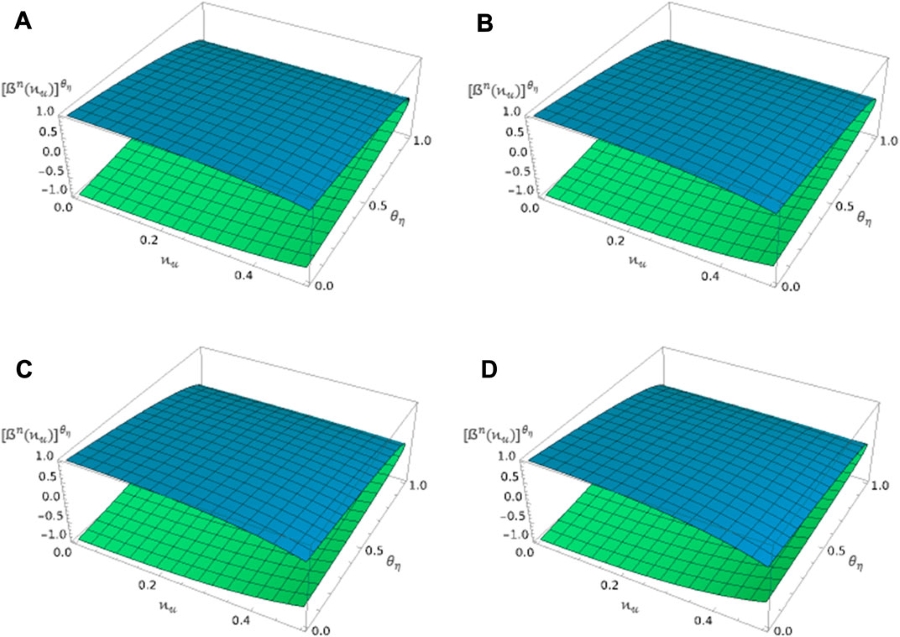
Illustrative Image: New Fixed Point Approximations with C-Class Akram and Generalized MJ Contractions: Advances in Metric Space Theory and Iterative Convergence
Image Source & Credit: Frontiers
Ownership and Usage Policy
A recent study by Omidire et al. (2025) titled “Approximating Fixed Point of Generalized C-class Contractivity Conditions” published in International Journal of Mathematical Sciences and Optimization: Theory and Applications reveals that the newly introduced contractivity conditions—C-Class Akram Contraction and C-Class Generalized MJ Contraction—successfully establish unique fixed points and unique common fixed points in metric spaces.
“
C-Class Akram and Generalized MJ contractions guarantee unique fixed and common fixed point convergence in metric spaces.– Omidire et al. 2025
This study focuses on approximating fixed points under novel contractivity conditions in metric spaces. It introduces two new types of contractivity conditions: C-Class Akram Contraction and C-Class Generalized MJ Contraction. The authors establish the convergence of Picard and Jungck iterations toward unique fixed points and unique common fixed points, respectively. Fixed point theory is a fundamental tool in mathematics, engineering, and other fields, as it helps solve complex nonlinear mathematical problems, such as optimization and differential equations. The study generalizes and extends several existing results in fixed point theory, incorporating concepts such as altering distance functions and C-class functions.
How the Study was Conducted
The study employed mathematical analysis and iterative methods within the framework of fixed point theory to introduce and investigate two novel contractivity conditions—C-Class Akram Contraction and C-Class Generalized MJ Contraction. By generalizing existing fixed point results, the researchers formulated new mathematical definitions and explored their properties in metric spaces.
To validate their findings, the authors utilized rigorous proof techniques to establish the existence and uniqueness of fixed points under these new contractivity conditions. The authors also analyzed the convergence behavior of Picard and Jungck iterative schemes, demonstrating that these processes reliably approximated unique fixed points. Furthermore, the study included comparative analyses with existing theories, extending classical results and highlighting the improved applicability of the proposed conditions. These combined methods underscore the effectiveness of the new contractivity conditions and mark a meaningful advancement in fixed point approximations.
What the Authors Found
The authors introduced two novel contractivity conditions—C-Class Akram Contraction and C-Class Generalized MJ Contraction—which successfully establish the existence and uniqueness of fixed points and common fixed points in metric spaces. These results generalize and extend several classical fixed point theorems, including those of Banach, Jungck, Kannan, and Akram contractions. Furthermore, they demonstrated that Picard Iteration converges to a unique fixed point under the C-Class Akram Contraction, while Jungck Iteration converges to a unique common fixed point under the C-Class Generalized MJ Contraction. These findings enhance the stability and efficiency of iterative methods in solving nonlinear mathematical problems such as optimization and differential equations.
Why is this important
This study is important because it advances fixed point theory, a fundamental tool used in mathematics, engineering, and optimization.
Enhancing Mathematical Techniques – The novel contractivity conditions improve existing fixed point results, making iterative methods more robust.
Solving Real-World Problems – Fixed point methods help in solving complex nonlinear problems, such as differential equations, optimization, and computational simulations.
Generalization of Existing Theorems – The research extends classical results like Banach’s contraction principle, making them applicable in broader scenarios.
Applications in Engineering and Science – Fixed point theory plays a key role in areas like control systems, economics, physics, and artificial intelligence.
Improving Algorithm Efficiency – The study establishes better conditions for convergence, making numerical methods more reliable.
What the Authors Recommended
The authors recommend further exploration of fixed point approximations under more generalized contractivity conditions in metric spaces. Specifically, they suggest:
- Investigating other types of contractivity conditions beyond C-Class Akram Contraction and C-Class Generalized MJ Contraction to refine fixed point results. Testing the effectiveness of their proposed conditions in broader mathematical structures like Banach spaces or Hilbert spaces.
- Exploring computational methods to apply these contractivity conditions for solving real-world problems in optimization, differential equations, and engineering.
- Further comparing their findings with classical fixed point results to highlight improvements in convergence speed and accuracy.
In conclusion, the study by Omidire et al. (2025) marks a significant advancement in fixed point theory by introducing novel contractivity conditions that ensure the existence and uniqueness of fixed points in metric spaces. Through rigorous mathematical analysis and iterative methods, the research not only generalizes classical results but also enhances the stability and efficiency of iterative schemes such as Picard and Jungck iterations. These findings have important implications for solving complex nonlinear problems across mathematics, engineering, and applied sciences, paving the way for future exploration and practical applications of fixed point approximations in diverse fields.

 January 2025: Professor Ali Baklouti – African Male Researcher of the Month