Overview
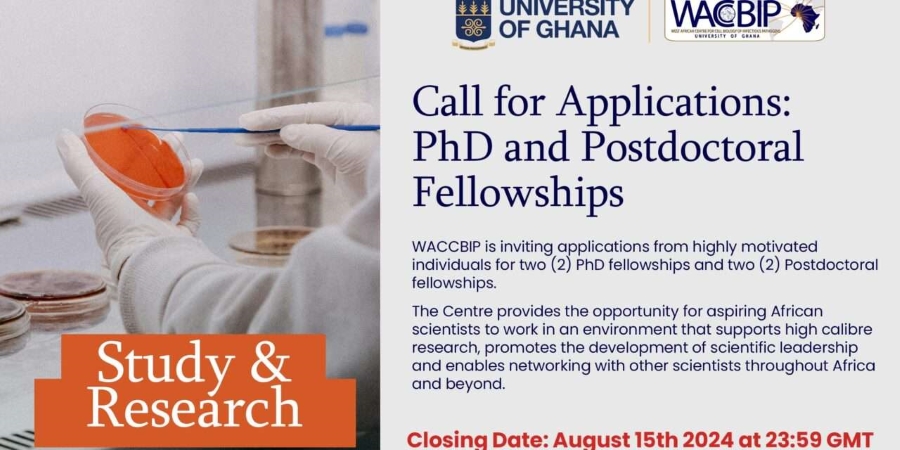
The West African Centre for Cell Biology of Infectious Pathogens (WACCBIP) is recognized as a premier Centre of Excellence in biomedical research. In collaboration with international partners, WACCBIP is offering fully-funded PhD and Postdoctoral fellowships. These fellowships provide a unique opportunity for aspiring African scientists to engage in cutting-edge research, gain scientific leadership skills, and establish vital networks within the global scientific community.
PhD Fellowships
WACCBIP invites applications from highly motivated individuals for two fully-funded PhD fellowships. Successful candidates will embark on a four-year PhD program at the University of Ghana, specializing in Chemistry, Biochemistry, or Molecular Cell Biology of Infectious Diseases.
Eligibility Criteria
- Applicants must be African nationals with a relevant Master’s degree.
- Candidates should demonstrate a strong interest in the specified research areas and a high level of motivation.
Fellowship Expectations
- Fellows will conduct high-quality research aimed at producing at least two publications in peer-reviewed journals.
- Participants will contribute to the training and mentorship of undergraduate students.
- Successful completion of the program will result in the award of a PhD degree from the University of Ghana.
Fellowship Benefits
- Full tuition coverage at the University of Ghana.
- A monthly stipend to cover living expenses.
- Provision of research supplies and reagents.
Available Research Projects
- Plasma Cell Longevity Markers as Predictors of Long-term Protection Post Vaccination and Infection
- Required Background: Strong foundation in immunology and molecular biology.
- Techniques: PBMC isolation, Serum collection, MACS, FACS, Fluorescence microscopy, Nucleic acid isolation, PCR/qPCR.
- Principal Investigator: Dr. Abdouramane Camara
- Structural Characterization of Key Maturation Intermediates for Structure-Guided Discovery of HIV Inhibitors Using X-Ray Crystallography and Single Particle Cryo-EM
- Required Background: Strong background in physical, biological, or biomedical sciences.
- Techniques: Cloning, Protein expression in bacteria or leishmania, Protein purification, Crystallization, CryoEM (experience advantageous).
- Principal Investigator: Dr. Jerry Joe Harrison
Postdoctoral Fellowships
WACCBIP is also offering two fully-funded Postdoctoral fellowships. These fellowships are designed for recent PhD graduates who are eager to pursue a research career in the biosciences within Africa. Fellows will be based at the University of Ghana and may collaborate with partner institutions such as the Medical Research Council Unit The Gambia, University of Lagos, and other prestigious institutions.
Eligibility Criteria
- Applicants must be African nationals who have obtained their PhD degree within the last five years.
- A strong interest in advancing research in the biosciences in Africa is essential.
- Candidates should have the ability to develop an innovative research proposal that can be completed within three years.
- A commitment to high research ethics standards and an interest in specified priority disease areas and research themes is required.
Fellowship Expectations
- Fellows are expected to conduct high-quality research leading to at least two publications in peer-reviewed journals.
- Fellows will contribute to the training and mentorship of graduate students.
- They are encouraged to secure external funding for new research projects.
- Fellows will enhance the research capacity at their host laboratories.
Fellowship Benefits
- A competitive monthly salary.
- Provision of research supplies and reagents.
- Opportunities to attend international conferences.
- Coverage of relocation costs for international fellows.
Priority Disease Areas Include
- Congenital and non-communicable diseases (e.g., Sickle Cell Disease, Cancer).
- Infectious diseases (e.g., Malaria, HIV/AIDS, Tuberculosis, COVID-19).
- Other pathogens (e.g., Schistosomiasis, Filariasis).
Research Themes Include
- Human genetics
- Disease pathogenesis and immunogenetics
- Pathogen genomics and bioinformatics
- Host-pathogen interactions
- Diagnostics and molecular epidemiology
- Pandemic preparedness
- Antimicrobial resistance
- Drug and vaccine discovery
Additional Opportunities
All fellowship recipients will have the opportunity to undertake three-month research visit to collaborating institutions such as the University of Cambridge, Francis Crick Institute, London School of Hygiene and Tropical Medicine, and others in the UK and USA.
Application Process
Interested applicants must download and complete the appropriate fellowship application form:
Completed applications should be saved as a single PDF file with the applicant’s full name and emailed to waccbipapplications@ug.edu.gh. The email subject line should clearly indicate the fellowship being applied for (PhD fellowship or Postdoctoral fellowship).
This is an excellent opportunity for emerging African scientists to contribute to vital research in the biosciences and to further their careers within a supportive and resource-rich environment. Don’t miss the chance to be part of this transformative program!
For more information, please CLICK HERE

 June 2024: Professor Abdon Atangana – African Male Researcher of the Month