Tag: Fluid Dynamics

  • Numerical Analysis of Magnetohydrodynamic Silver Nanofluid Flow in Cylindrical Coordinates: Heat Transfer, Magnetic Field Effects, and Applications

    Numerical Analysis of Magnetohydrodynamic Silver Nanofluid Flow in Cylindrical Coordinates: Heat Transfer, Magnetic Field Effects, and Applications


    Illustrative Image: Numerical Analysis of Magnetohydrodynamic Silver Nanofluid Flow in Cylindrical Coordinates: Heat Transfer, Magnetic Field Effects, and Applications
    Image Source & Credit: MDPI
    Ownership and Usage Policy

    A recent study by Ojo et al. (2025) titled “NUMERICAL ANALYSIS OF ENERGY TRANSFER ON MAGNETOHYDRODYNAMIC SILVER NANOFLUID FLOW IN CYLINDRICAL COORDINATE” published in Open Journal of Physical Science (ISSN: 2734-2123), reveals that applying a magnetic field alters silver nanofluid flow in cylinders, enhancing thermal conductivity yet reducing velocity and modifying boundary layer behavior.

    Magnetic fields enhance silver nanofluid thermal conductivity but reduce velocity, significantly influencing heat transfer in cylindrical systems. – Ojo et al. 2025

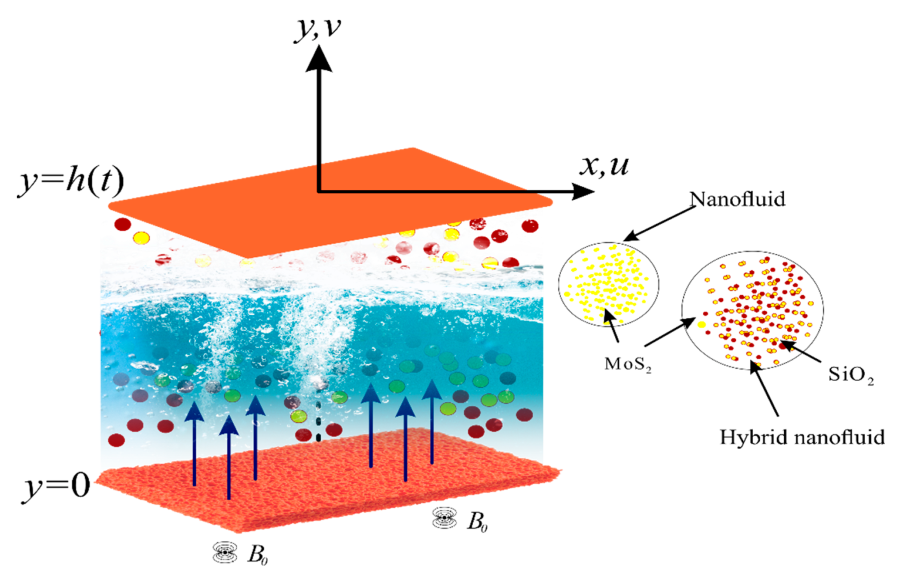
    The study explores the intricate relationship between fluid dynamics, magnetic fields, and heat transfer. Focusing on silver nanofluids—fluids infused with silver nanoparticles renowned for their superior thermal conductivity—the research investigates how these advanced materials respond to magnetic influences in cylindrical systems such as pipes, reactors, and biomedical devices. At its core, the study applies magnetohydrodynamics (MHD) to numerically simulate the transfer of energy within silver nanofluids under varying conditions. By analyzing parameters such as magnetic field strength, fluid velocity, and thermal conductivity, the research provides key insights into how magnetic forces shape fluid behavior and heat transport efficiency. The findings hold significant promise for real-world applications, ranging from industrial cooling systems and energy technologies requiring precise thermal regulation to biomedical innovations, including drug delivery mechanisms controlled by magnetic fields.

    How the Study Was Conducted

    The study employed a numerical simulation approach, where mathematical models were developed and solved computationally rather than through physical experiments. The governing equations were derived from the fundamental principles of fluid dynamics and heat transfer, including the continuity equation for mass conservation, momentum equations modified to account for magnetic effects, and the energy equation to describe heat transfer. Since the system under consideration resembled pipe-like structures, the equations were expressed in cylindrical coordinates. To capture the influence of magnetic fields, the Lorentz force was incorporated into the momentum equations. A uniform transverse magnetic field was assumed, which directly impacted both the motion of the silver nanofluid and its heat transfer behavior. Silver nanoparticles were chosen for the study because of their exceptionally high thermal conductivity. The fluid’s effective thermophysical properties were modeled by combining the characteristics of the base fluid with those of the nanoparticles. The system of equations was solved numerically using the finite difference method, a reliable technique for approximating differential equations. Appropriate boundary conditions were applied to simulate realistic flow scenarios within the cylindrical framework. The simulations generated graphical results that highlighted the variations in velocity, temperature distribution, and heat transfer rates under different operating conditions, particularly changes in magnetic field strength and nanoparticle concentration.

    What the Authors Found

    The authors found that applying a magnetic field significantly modifies the flow and heat transfer of silver nanofluids in cylindrical systems, with silver nanoparticles enhancing thermal conductivity but the magnetic field suppressing velocity and altering boundary layer behavior.

    Why is this important

    Engineering Efficiency – Silver nanofluids enhance cooling in electronics, reactors, and machinery, while magnetic fields enable fine-tuned thermal control.

    Biomedical Applications – Insights help optimize nanoparticle behavior for targeted drug delivery and hyperthermia cancer treatments.

    Environmental & Energy Impact – Improved heat transfer reduces energy use, supporting clean energy and sustainability.

    Scientific Contribution – Advances magnetohydrodynamics by linking fluid mechanics, electromagnetism, and thermodynamics for innovative technologies.

    What the Authors Recommended

    • While silver nanoparticles showed promising thermal performance, the authors suggested investigating other nanoparticle materials to compare efficiency and cost-effectiveness.
    • They recommended conducting physical experiments to validate the numerical results and strengthen the reliability of the simulation models.
    • Future work should focus on optimizing parameters such as magnetic field strength, nanoparticle concentration, and flow geometry to maximize heat transfer.
    • The authors encouraged tailoring the model to real-world systems like biomedical devices, heat exchangers, and microfluidic channels for more targeted insights.
    • In addition, they proposed incorporating factors like radiation, chemical reactions, or variable viscosity to make the model more comprehensive and realistic.

    In conclusion, this study demonstrates how silver nanofluids under magnetic influence can revolutionize heat transfer technologies, offering transformative benefits across engineering, biomedical, and energy applications while paving the way for more efficient, sustainable, and innovative solutions.

  • Unlocking the Power of the Weighted Average Method for Solving Nonlinear PDEs: Insights from the Burger-Fisher Equation

    Unlocking the Power of the Weighted Average Method for Solving Nonlinear PDEs: Insights from the Burger-Fisher Equation

    A study by Loyinmi et al. (2025) titled “Exploring the Efficacy of the Weighted Average Method for Solving Nonlinear Partial Differential Equations: A Study on the Burger-Fisher Equation” published in EDUCATUM Journal of Science, Mathematics, and Technology reveals that WAM provides a stable and accurate numerical approach for solving the Burger-Fisher equation, making it a valuable tool for researchers dealing with nonlinear PDEs.

    The Weighted Average Method (WAM) is a stable, accurate, and reliable numerical approach for solving nonlinear partial differential equations. – Loyinmi et al. 2025

    The study “Exploring the Efficacy of the Weighted Average Method for Solving Nonlinear Partial Differential Equations: A Study on the Burger-Fisher Equation” investigates the effectiveness of the Weighted Average Method (WAM) in solving the Burger-Fisher equation, a nonlinear partial differential equation (PDE) that plays a crucial role in fields such as fluid dynamics, population dynamics, and chemical kinetics. This equation integrates aspects of both the Burgers equation and Fisher equation, making it essential for modeling convection, diffusion, and reaction processes, particularly in phenomena like shock wave formation and turbulence.

    The Weighted Average Method discretizes spatial and temporal derivatives using a combination of forward, backward, and central differences. Its numerical implementation involves solving a tridiagonal matrix system at each time step, demanding substantial computational resources. To facilitate this, the study employs MATLAB and MAPLE for numerical computations. Comprehensive convergence and stability analyses validate the method’s reliability and accuracy, with comparisons against exact solutions revealing minimal errors, reinforcing the method’s effectiveness.

    The findings demonstrate that WAM provides a stable and accurate numerical approach for solving the Burger-Fisher equation, making it a valuable tool for researchers dealing with nonlinear PDEs. The study underscores the importance of fine-tuning numerical parameters and leveraging computational techniques to enhance accuracy. Ultimately, this research contributes to the advancement of numerical methods, offering practical insights for solving complex mathematical models in various scientific and engineering applications.

    How the Study was Conducted

    The weighted average method discretizes both spatial and temporal derivatives using a combination of forward, backward, and central differences. The method’s implementation involves solving a tridiagonal matrix system at each time step, requiring significant computational resources. Mathematical software like MATLAB and MAPLE are utilized for computations. The convergence and stability analyses are conducted to ensure the method’s reliability and accuracy. The study compares numerical solutions obtained via the weighted average method with exact solutions, finding negligible errors that confirm the method’s accuracy.

    What the Authors Found

    The authors findings demonstrate that WAM is a highly accurate, stable, and practical numerical method for addressing complex nonlinear PDEs. These results have significant implications for scientific and engineering applications, offering a robust computational tool for solving challenging mathematical problems.

    Why is this important?

    Advancing Numerical Methods: The Weighted Average Method (WAM) is demonstrated to be highly accurate and reliable for solving nonlinear partial differential equations (PDEs), like the Burger-Fisher equation. This contributes to the advancement of numerical methods, providing researchers with a powerful tool for addressing complex mathematical problems.

    Practical Applications: The Burger-Fisher equation models phenomena such as convection, diffusion, and reaction processes, which are fundamental in various scientific disciplines like fluid dynamics, population dynamics, and chemical kinetics. The ability to solve this equation accurately has practical implications in these fields, aiding in the development of predictive models and enhancing our understanding of these processes.

    Improving Computational Techniques: By utilizing mathematical software like MATLAB and MAPLE to implement the Weighted Average Method, the study highlights the importance of leveraging computational resources. This approach ensures high accuracy and stability in solving nonlinear PDEs, which is essential for practical applications and further research.

    Cross-Disciplinary Relevance: The study’s findings are not limited to the Burger-Fisher equation alone but have broader implications for other nonlinear PDEs encountered in diverse scientific and engineering fields. The principles and methodologies developed in this research can be applied to a wide range of problems, making the study valuable across multiple disciplines.

    Improving Accuracy in Predictions: Accurate numerical solutions to nonlinear PDEs, like those provided by the Weighted Average Method, are crucial for developing reliable predictive models. These models are essential for understanding and forecasting behaviors in complex systems, from fluid flow and heat transfer to biological processes and chemical reactions.

    Foundation for Further Studies: The study’s rigorous analysis of stability and convergence, as well as its demonstration of the practical utility of the Weighted Average Method, provides a solid foundation for future research. Researchers can build on these findings to develop even more efficient and accurate numerical methods for solving nonlinear PDEs.

    What the Authors Recommended

    Based on the finding, the authors recommend the following:

    • Parameter Optimization: Researchers should focus on fine-tuning numerical parameters, such as the time step size (Δ𝑡) and spatial step size (Δ𝑥), to achieve optimal accuracy when using the Weighted Average Method (WAM) for solving nonlinear PDEs like the Burger-Fisher equation.
    • Computational Resources: The study emphasizes the importance of leveraging computational resources effectively. Utilizing mathematical software like MATLAB and MAPLE can help manage the computational demands of solving the tridiagonal matrix system at each time step.
    • Application to Other Nonlinear PDEs: The authors suggest that the Weighted Average Method, demonstrated to be effective for the Burger-Fisher equation, could be applied to other nonlinear partial differential equations. This can further validate the method’s robustness and versatility across different scientific and engineering fields.
    • Further Research: The study encourages future research to build on their findings by exploring the application of WAM to more complex and higher-dimensional nonlinear PDEs. This could expand the method’s applicability and contribute to the development of more advanced numerical techniques.
    • Practical Implementations: Practitioners and researchers are encouraged to use the Weighted Average Method for practical applications in fields such as fluid dynamics, population dynamics, and reaction-diffusion systems. The method’s high accuracy and stability make it a valuable tool for developing reliable predictive models.
    • Stability and Convergence Analyses: The authors recommend conducting thorough stability and convergence analyses for any numerical method applied to nonlinear PDEs. Ensuring the method’s reliability through these analyses is crucial for achieving precise numerical approximations.

    In conclusion, the study by Loyinmi et al. (2025) highlights the effectiveness of the Weighted Average Method (WAM) as a stable and accurate numerical approach for solving nonlinear partial differential equations like the Burger-Fisher equation. By leveraging advanced computational tools such as MATLAB and MAPLE, the research underscores the importance of optimizing numerical parameters and conducting rigorous stability and convergence analyses. The findings not only contribute to the advancement of numerical methods but also have far-reaching implications across various scientific and engineering disciplines, from fluid dynamics to chemical kinetics. As researchers continue to refine and expand the applications of WAM, this study serves as a valuable foundation for future developments in computational mathematics and predictive modeling.

  • Fostering Collaboration: The Leeds-Africa Hub for Data Analytics in Mathematical & Physical Sciences Research

    Fostering Collaboration: The Leeds-Africa Hub for Data Analytics in Mathematical & Physical Sciences Research

    The Leeds-Africa Hub on Data Science and AI across mathematics and sciences serves as a platform for exchanging knowledge and insights in research areas profoundly impacted by advancements in Artificial Intelligence, Machine Learning, and Data Science. Our primary goal is to foster collaboration by bringing together experts from both the UK and across Africa, facilitating new partnerships and encouraging researchers to share their work with diverse communities.

    “The Hub,” which aims to foster collaborations between the University of Leeds (UoL) and less developed countries (LDCs) to address global challenges using physical and mathematical sciences. The main objective is to develop collaborative research projects that tackle sustainable development challenges, including climate science, bioinformatics, ecosystem functioning, and industrial and technological advancement. By combining expertise from the UoL and overseas partners, the Hub seeks to promote the growth of LDCs while ensuring the preservation of their local environment and the global environment.

    Planned Activities

    Workshops: The Hub plans to organize initial workshops in South Africa during September 2023. These workshops will facilitate connections with international partners and facilitate the exchange of knowledge. Hackathons on data science challenges related to Hub themes will be proposed during the workshops, focusing on areas like bioinformatics and climate science.

    Research Exchanges: The Hub aims to conduct research exchanges where academics will travel between the UoL and partner countries for approximately one week each. Additionally, longer-term exchanges will involve around six PhD students in the first year, traveling between the UoL and partner countries. These exchanges will strengthen collaborations, explore cutting-edge scientific problems, and broaden the horizons of participating students. The goal is to enable joint supervision of master’s and PhD projects, further solidifying research partnerships with LDCs.

    Long term:

    The Hub envisions hosting a summer school on data analytics in a partner country, potentially the University of Pretoria, during the second year of the initiative. This summer school would involve around 50 students from both the UK and African countries, providing training in machine learning and data analysis at MSc/PhD level. The school would foster research capacity for researchers in LDCs and offer valuable training to students from Leeds and other UK institutions. It would also help to establish connections that could lead to joint PhD supervision and strengthen research collaborations.

    Areas of Anticipated Research Collaboration

    The Hub aims to collaborate on various research areas, including:

    Machine learning for the characterization and classification of objects and patterns in multi-wavelength imaging datasets, applicable in Earth observation, medical imaging, and astronomy.

    Methods for data analysis in bioinformatics, specifically focusing on single cell genomic denoising and sparsity modeling. This would contribute to resolving challenges in trajectory analysis, pseudotime estimation, and network inference.

    Analysis of animal tracking data and ecosystem function modeling in collaboration with the Department of Statistics. The Hub presents an opportunity for researchers to collaborate in analyzing animal population data in African countries alongside local researchers and institutes.

    Applications of machine learning and AI in fluid dynamics, where Leeds Institute for Fluid Dynamics and its Machine Learning/Data group with over 100 members offer opportunities for collaboration in data analysis for fluids and future funding bids.

    Machine Learning and AI applications in the environment and finance, aiming to explore the synergy between statistics and machine learning for environmental prediction, ML methods for insurance pricing, and interpretability of ML/AI models.

    Primary Investigators and Funding Details

    The primary investigators for the Hub are Dr. Richard Mann and Dr. John Ilee. The project is scheduled to commence on 1 February 2023 and conclude on 31 December 2023, with a total value of £100,000.