
Tag: Engineering Professors

  • MIT-Empowering the Teachers (MIT-ETT) Programme: Transforming Science and Engineering Education in Nigeria

    MIT-Empowering the Teachers (MIT-ETT) Programme: Transforming Science and Engineering Education in Nigeria

    Application Deadline: May 26, 2024

    The MIT-Empowering the Teachers (MIT-ETT) Programme invites applications for its upcoming cycle. This initiative targets engineering professors currently teaching at local Nigerian universities who have recently attained their Ph.D. degrees.

    The essence of the MIT-ETT Program lies in its commitment to fostering innovation in science and engineering education across African tertiary institutions. By selecting cohorts of faculty members (ETT Fellows) and immersing them in an intensive, semester-long teaching-focused experience, the program aims to introduce cutting-edge, student-centered teaching methodologies.

    At its core, MIT-ETT strives to cultivate young African faculty leaders in science and engineering education, instilling in them the capacity to drive change and infuse creativity into curricular development. This is pursued through two primary objectives:

    1. Exposing junior African professors to MIT’s advanced, problem-solving pedagogical methods.
    2. Providing a platform for American faculty, particularly those interested in engaging with emerging economies, to connect and collaborate with counterparts from African universities.

    During their semester at MIT, ETT Fellows engage in a multifaceted learning journey:

    • Observing at least two MIT courses within their own disciplines.
    • Participating in a curriculum design course, where they implement research-based instructional design principles in their own teaching.
    • Engaging in discussions and explorations on curricular enrichment and reform through formal and informal interactions with the MIT community.
    • Participating in a range of activities aimed at developing critical change-agent skills, such as entrepreneurship, effective communication, experiential learning, reflection, collaboration, systems thinking, and perseverance.

    Ultimately, the vision for the universities where ETT Fellows teach is to nurture undergraduate students who are equipped with the requisite skills for today’s job market, including hands-on problem-solving and critical thinking capabilities.

    The MIT-ETT Program boasts corporate sponsorship from NNPC Ltd. & TotalEnergies EP Nigeria, underscoring the significance of industry collaboration in driving educational innovation.

    The application process for the MIT-Empowering the Teachers Programme is now open until May 26, 2024. Prospective applicants are encouraged to visit the registration page and follow the outlined instructions for submission.

    For further inquiries regarding the application process, applicants may reach out to ett.support@mit.edu.

    Visit the Official Webpage of the MIT Africa Empowering the Teachers Fellowship Programme
  • Unmasking the Mystery: The Curious Case of Prof Jephias Mapuva and the African Journal of Political Science

    Unmasking the Mystery: The Curious Case of Prof Jephias Mapuva and the African Journal of Political Science

    Recently, Retraction Watch reported a disturbing incident where a professor found her name on an article she didn’t write, which appeared to be plagiarized. Further investigation revealed some intriguing details about the journal responsible for publishing the article, the African Journal of Political Science.

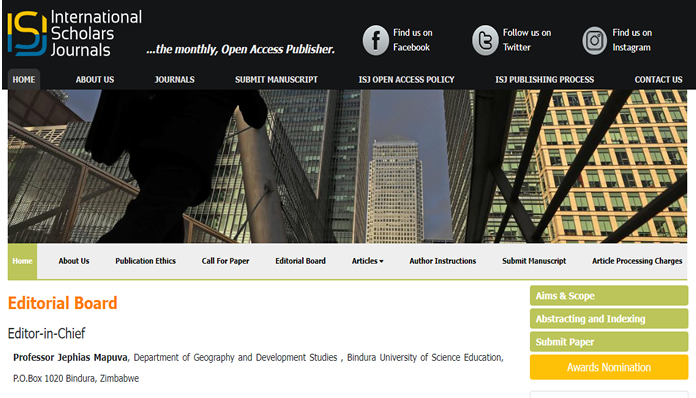
    Jephias Mapuva, a professor at Bindura University of Science Education in Zimbabwe, listed as the editor-in-chief of the journal, denied any association with it and expressed surprise at being falsely credited. He contacted the journal’s publisher, International Scholars Journal, to request the removal of his name from the website, as it posed an inconvenience to his profile.

    Examining the journal’s editorial board, it was found to include engineering professors and a “Commercial Manager of Multifarious Projects Group” from India. Commenters pointed out that another African Journal of Political Science, affiliated with the African Association of Political Science and operating as an open-access journal without article processing fees, exists with the same ISSN listed on the International Scholars Journals website. The International Scholars Journals publication has been continuously publishing since 2007, whereas the other journal halted its publications in 2004 and resumed in the previous year.

    International Scholars Journals has faced scrutiny, being mentioned in Jeffrey Beall’s list of “potentially predatory journals and publishers.” Beall, a librarian at the University of Colorado, Denver, maintained the list until 2017, but archived versions still exist online.

    Commenters shared their experiences with the alleged African Journal of Political Science. One academic described the journal’s push for money after inviting a commentary submission. The journal’s aggressive behavior, charging high fees and ignoring requests to withdraw articles, was deemed fraudulent and akin to spearphishing.

    Regarding the publication of an article under someone else’s name, commenters speculated that the publisher might aim to fill its issues with content and add an air of legitimacy by associating the work with reputable academics. Similar attempts using famous authors’ names, like Walt Whitman and Charlotte Brontë, have been previously reported.