Tag: article

  • Unmasking the Mystery: The Curious Case of Prof Jephias Mapuva and the African Journal of Political Science

    Unmasking the Mystery: The Curious Case of Prof Jephias Mapuva and the African Journal of Political Science

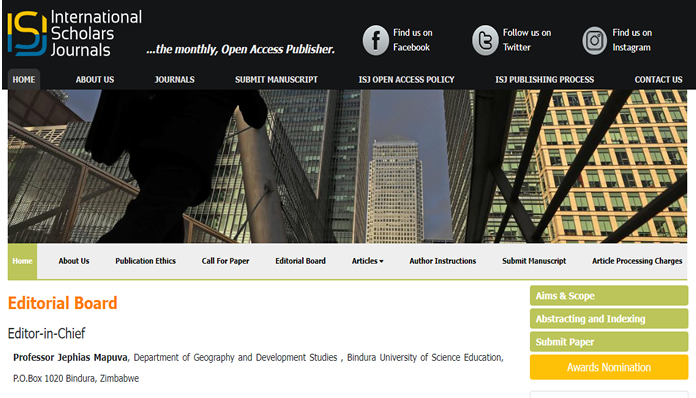
    Recently, Retraction Watch reported a disturbing incident where a professor found her name on an article she didn’t write, which appeared to be plagiarized. Further investigation revealed some intriguing details about the journal responsible for publishing the article, the African Journal of Political Science.

    Jephias Mapuva, a professor at Bindura University of Science Education in Zimbabwe, listed as the editor-in-chief of the journal, denied any association with it and expressed surprise at being falsely credited. He contacted the journal’s publisher, International Scholars Journal, to request the removal of his name from the website, as it posed an inconvenience to his profile.

    Examining the journal’s editorial board, it was found to include engineering professors and a “Commercial Manager of Multifarious Projects Group” from India. Commenters pointed out that another African Journal of Political Science, affiliated with the African Association of Political Science and operating as an open-access journal without article processing fees, exists with the same ISSN listed on the International Scholars Journals website. The International Scholars Journals publication has been continuously publishing since 2007, whereas the other journal halted its publications in 2004 and resumed in the previous year.

    International Scholars Journals has faced scrutiny, being mentioned in Jeffrey Beall’s list of “potentially predatory journals and publishers.” Beall, a librarian at the University of Colorado, Denver, maintained the list until 2017, but archived versions still exist online.

    Commenters shared their experiences with the alleged African Journal of Political Science. One academic described the journal’s push for money after inviting a commentary submission. The journal’s aggressive behavior, charging high fees and ignoring requests to withdraw articles, was deemed fraudulent and akin to spearphishing.

    Regarding the publication of an article under someone else’s name, commenters speculated that the publisher might aim to fill its issues with content and add an air of legitimacy by associating the work with reputable academics. Similar attempts using famous authors’ names, like Walt Whitman and Charlotte Brontë, have been previously reported.

  • August 2023: Dr Mirriam Makungwe – African Female Researcher of the Month

    August 2023: Dr Mirriam Makungwe – African Female Researcher of the Month

    African Researchers Award
    August 2023: Dr Mirriam Makungwe – African Female Researcher of the Month

    Mirriam Makungwe is a seasoned professional with a Ph.D. in Integrated Soil Fertility Management from the University of Zambia. Currently serving as a Research Officer at the International Water Management Institute (IWMI), she brings over 12 years of hands-on experience in the agricultural sector, specializing in collaborating with smallholder farmers to implement strategic initiatives that tackle challenges within agriculture and food systems.

    Mirriam’s career aspiration revolves around becoming a pivotal figure in enhancing food security. She aims to achieve this by conducting cutting-edge research that centers on the application of spatial modeling of soil fertility data. Her research aims to offer solutions that significantly elevate the quality of life and health of rural communities.

    In 2022, Mirriam Makungwe clinched the coveted 2022 CSC Research Output Stream award. This prestigious recognition was bestowed upon her for her groundbreaking article, “Assessing Land Suitability for Rainfed Paddy Rice Production in Zambia,” published in Geoderma Regional. As a distinguished 2019 Split-site Scholar from Zambia, she successfully attained a Ph.D. in Integrated Soil Fertility Management from both the University of Nottingham and the University of Zambia.

    Mirriam’s research addresses the pressing issue of low agricultural productivity, a critical barrier to achieving food security and fostering rural prosperity in Zambia and Sub-Saharan Africa. Her article fills a crucial gap by evaluating the suitability of Zambia’s land for cultivating rice, specifically rainfed paddy rice. This research not only benefits farmers but also informs policymakers, the private sector, and researchers along the value chain.

    Her study outcomes have led her to delve deeper into researching alternative rice crops, specifically irrigated and upland rice production. Encouragingly, her findings indicate promising potential for irrigated upland rice production in Zambia. These discoveries hold the potential to support Zambia’s National Rice Development Strategy (NRDS) and bolster rice crop production models in the Zambezi region.

    Mirriam’s research endeavors were undertaken during her Commonwealth Split-site Scholarship at the University of Nottingham’s School of Biosciences and the Future Food Beacon. She actively contributed to the International Institute for Applied Systems Analysis (IIASA) under the Sustainability Nexus Research Cluster and Ecosystem Management and Services Program (SNR/ESM).

    In acknowledgment of her research contributions, Mirriam earned recognition as a One Planet Laureate Candidate by African Women in Agricultural Research and Development (AWARD). This distinction is part of a three-year career development program aimed at cultivating a network of scientific leaders committed to pioneering research that aids Africa’s smallholder farmers in adapting to a changing climate.

    Following the completion of her Ph.D. in April 2022, Mirriam secured an Innovative Metrics and Methods for Agriculture and Nutrition Actions (IMMANA) Post-Doctoral Fellowship. Her research for this fellowship entails evaluating Zinc supply in staple crops and soil across diverse soil types in Zambia.

    Currently, Mirriam is a Research Officer at the International Water Management Institute (IWMI), specializing in Innovation Scaling. She’s an active member of Zambian Women in Agricultural Research and Development (ZaWARD) and serves as an Africademics Scholarship Ambassador. Her research aligns with Sustainable Development Goals 2 and 12, as well as the CSC Development Theme Science and technology for development.

    Mirriam Makungwe, based in Zambia, also contributes her expertise as an Agricultural Water Resource Management and Horticulture Expert at NIRAS International Consulting. Armed with a Ph.D. and Master’s degree in Integrated Soil Fertility Management from the University of Zambia, she has garnered several prestigious scholarships, including the Commonwealth split-site scholarship, the One Planet fellowship by AWARD, and the Alliance for Green Revolution in Africa (AGRA) scholarship.